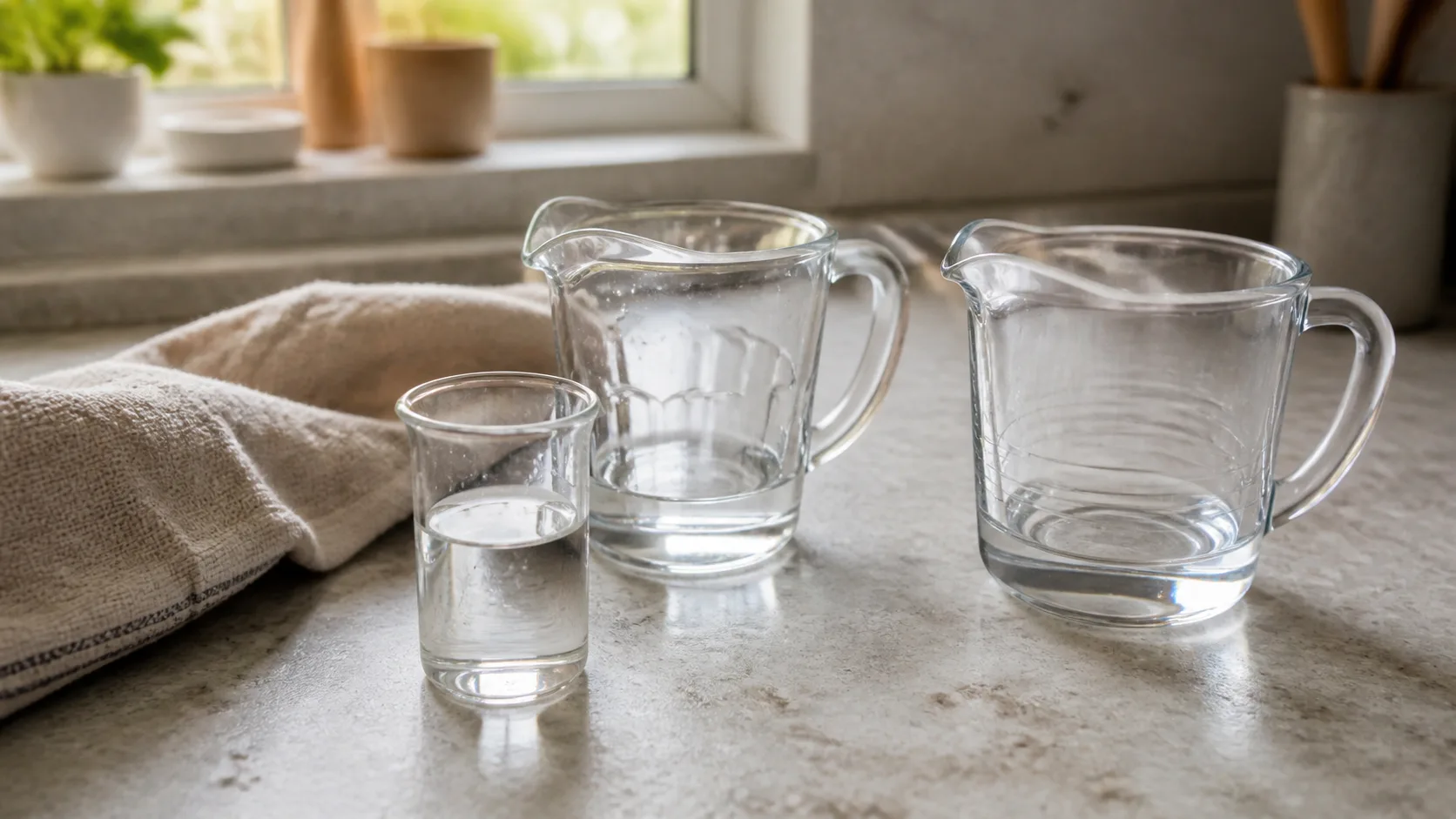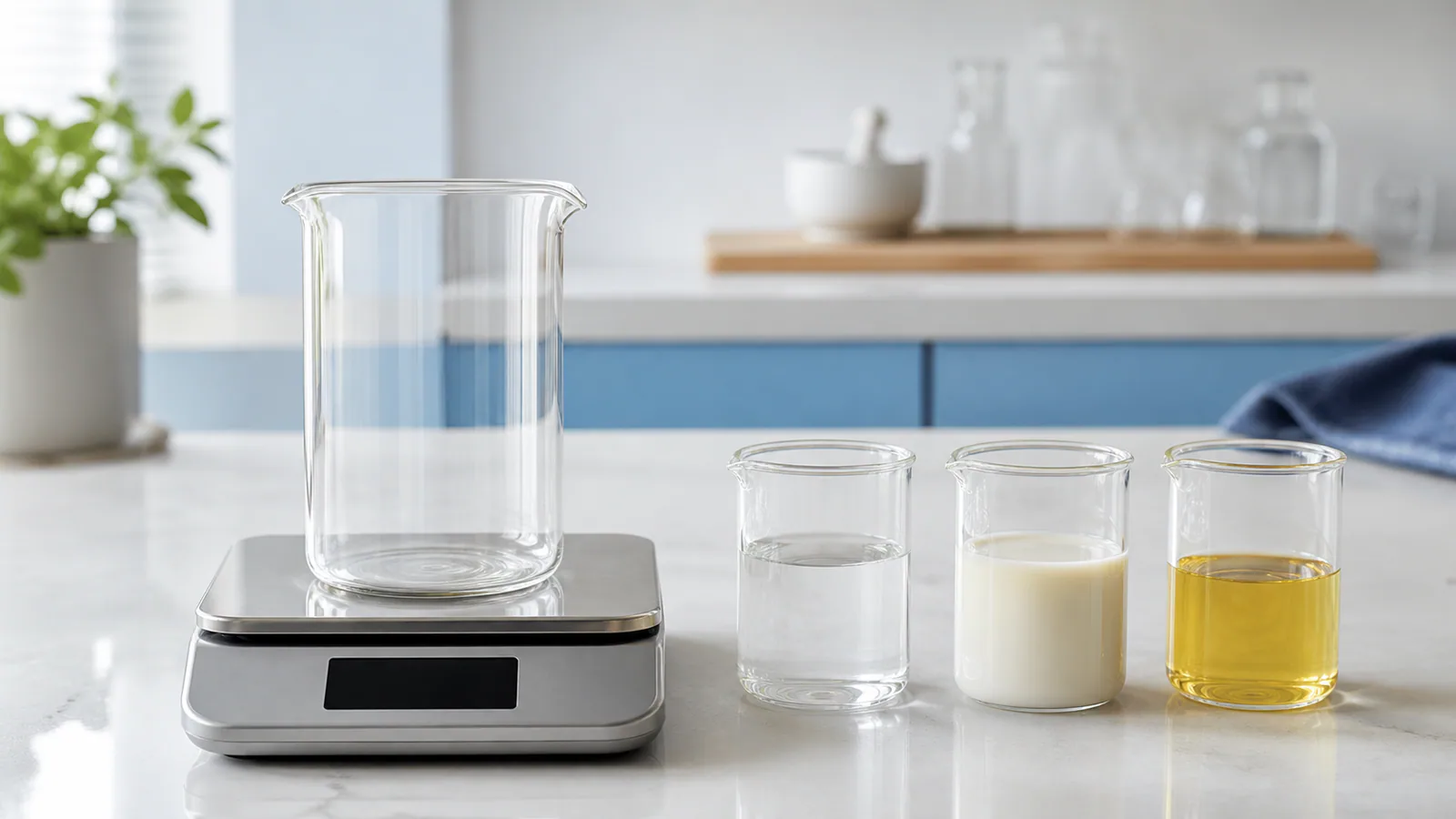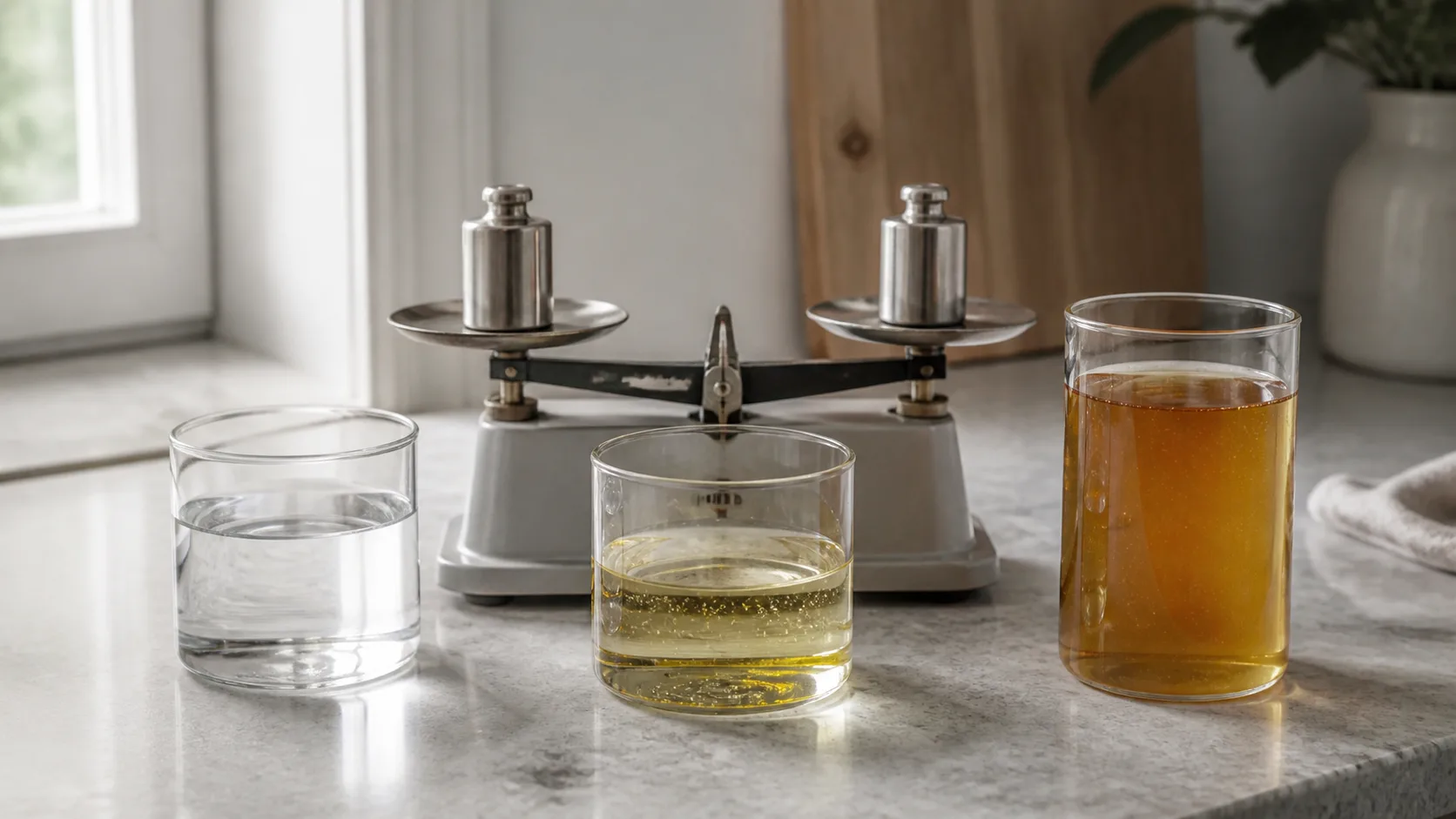
The answer to how many ml in a kg depends on the substance. A kilogram measures mass, while a milliliter measures volume. For water, 1 kg is approximately 1,000 mL. For another material, divide 1,000 grams by its density in grams per milliliter.
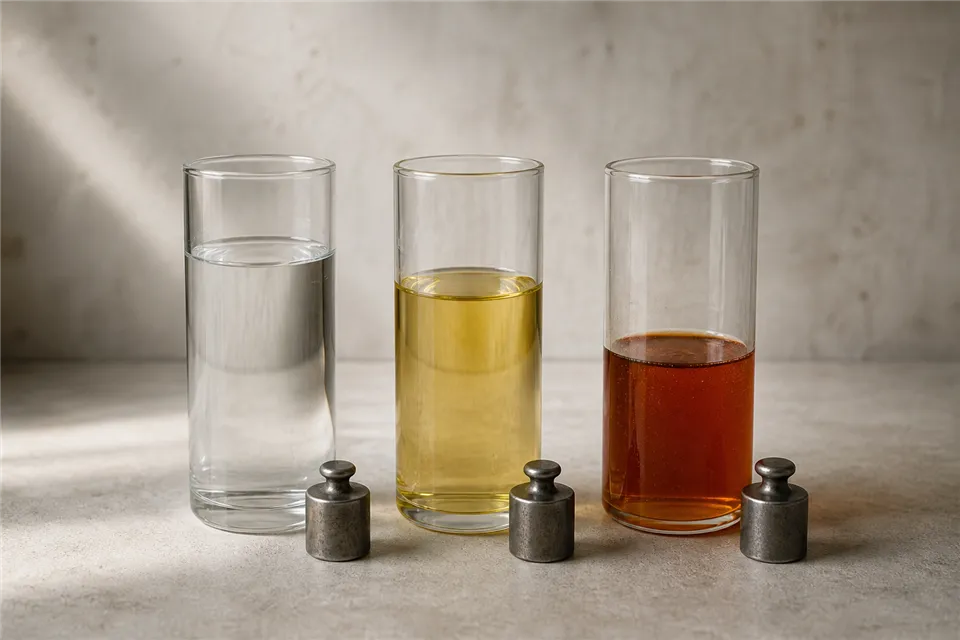
This distinction matters because equal masses do not always occupy equal amounts of space. One kilogram of oil occupies more volume than 1 kg of water because oil is less dense. One kilogram of honey occupies less volume because honey is denser.
Once the density is known, the conversion is straightforward. This guide explains the formula, shows how water, milk, oil, honey, flour, and sugar compare, and identifies the factors that can change the result.
Quick Answer
There is no universal number of milliliters in one kilogram. For water, the common household conversion is:
1 kg of water ≈ 1,000 mL For another substance:
V(mL) = m(kg) × 1,000 ÷ ρ(g/mL) Here, (m) is mass and (ρ) is density.
Kilograms and Milliliters Measure Different Things
A kilogram and a milliliter belong to different measurement categories. This is why converting between them requires more information than an ordinary metric conversion.
A kilogram measures mass
The kilogram, written as kg, is the SI base unit of mass:
1 kg = 1,000 g Mass describes the quantity of matter in an object or substance. In everyday conversation, people often call a kilogram a unit of weight. Technically, weight is a force caused by gravity, while kilograms measure mass.
A milliliter measures volume
A milliliter, written as mL, measures the space occupied by a substance:
1 mL = 0.001 L A milliliter is also equal to one cubic centimeter:
1 mL = 1 cm³ The UK spelling is “millilitre,” but the unit symbol remains mL.
Because kg measures mass and mL measures volume, there is no direct fixed conversion between them. Density provides the missing connection.
How Many mL in a kg at Different Densities?
A useful way to understand the conversion is to compare a material’s density with 1 g/mL.
Density equals 1 g/mL
If the density is exactly 1 g/mL:
V = 1,000 ÷ 1 = 1,000 mL This is the familiar household approximation used for water.
Density is below 1 g/mL
A material with a density below 1 g/mL occupies more than 1,000 mL per kilogram.
For example, using an oil density of 0.92 g/mL:
V = 1,000 ÷ 0.92 ≈ 1,087 mL The oil requires more container space because each milliliter contains less mass than a milliliter of water.
Density is above 1 g/mL
A material with a density above 1 g/mL occupies less than 1,000 mL per kilogram.
Using a honey density of 1.42 g/mL:
V = 1,000 ÷ 1.42 ≈ 704.2 mL Each milliliter of honey contains more mass, so fewer milliliters are needed to make 1 kg.
The basic rule is:
-
Below 1 g/mL means more than 1,000 mL per kilogram
-
At 1 g/mL means 1,000 mL per kilogram
-
Above 1 g/mL means less than 1,000 mL per kilogram
The kg-to-mL Conversion Formula
Density is defined as mass divided by volume:
ρ = m ÷ V Rearrange the equation to find volume:
V = m ÷ ρ If mass is entered in kilograms and density is expressed in grams per milliliter, convert kilograms to grams by multiplying by 1,000:
V(mL) = m(kg) × 1,000 ÷ ρ(g/mL) For exactly 1 kg, the formula becomes:
V(mL) = 1,000 ÷ ρ(g/mL)
Density expressed in kg/L
One kg/L is numerically equal to one g/mL. Therefore, the same practical formula can be used:
V(mL) = m(kg) × 1,000 ÷ ρ(kg/L) For example, a liquid with a density of 1.25 kg/L has the same numerical density as 1.25 g/mL.
Density expressed in kg/m³
If a specification lists density in kilograms per cubic meter, use:
V(mL) = m(kg) × 1,000,000 ÷ ρ(kg/m³) Suppose a liquid has a density of 800 kg/m³:
V = 1 × 1,000,000 ÷ 800 V = 1,250 mL Before calculating, check that the density unit matches the version of the formula being used.
Why 1 kg of Water Is About 1,000 mL
Water is commonly assigned a density of approximately 1.00 g/mL for household and cooking conversions.
Using that approximation:
V = 1 × 1,000 ÷ 1.00 V = 1,000 mL Therefore:
1 kg water ≈ 1,000 mL = 1 L This is an approximation rather than a permanent, exact identity. Water density changes slightly with temperature and pressure. Its density is close to, but not exactly, 1 g/mL under many ordinary conditions.
The practical difference is usually too small to matter when measuring water for a recipe. It may matter in laboratory calibration, manufacturing, or other precision work. In those situations, use a temperature-specific density instead of automatically entering 1.000 g/mL.
The modern liter is not defined as the volume of 1 kg of water. A liter is a special name for one cubic decimeter. The near 1 kg-to-1 L relationship comes from water’s density, not from a universal mass-to-volume rule.
One Kilogram of Common Ingredients
The following table compares the approximate volume occupied by 1 kg of several materials.
| Substance | Illustrative density | Approximate volume of 1 kg |
|---|---|---|
| Water | 1.000 g/mL | 1,000 mL |
| Milk | 1.030 g/mL | 970.9 mL |
| Vegetable oil | 0.920 g/mL | 1,087.0 mL |
| Honey | 1.420 g/mL | 704.2 mL |
| Granulated sugar | 0.850 g/mL | 1,176.5 mL |
| All-purpose flour | 0.530 g/mL | 1,886.8 mL |
These values are calculated from the displayed densities. They are useful illustrations, not fixed values for every product.
One kilogram of milk
Using an assumed density of 1.03 g/mL:
V = 1,000 ÷ 1.03 V ≈ 970.9 mL Milk is slightly denser than water, so 1 kg occupies slightly less than 1,000 mL. The exact density varies with fat, protein, sugar, temperature, and product formulation.
One kilogram of vegetable oil
Using an assumed density of 0.92 g/mL:
V = 1,000 ÷ 0.92 V ≈ 1,087.0 mL Vegetable oil is less dense than water, so 1 kg occupies more than one liter. Different oils and temperatures can produce different results.
One kilogram of honey
Using an illustrative density of 1.42 g/mL:
V = 1,000 ÷ 1.42 V ≈ 704.2 mL Honey is considerably denser than water. Its exact density varies with moisture content, composition, and temperature.
These examples answer why a container that holds 1 kg of honey may look much smaller than one holding 1 kg of cooking oil. The masses are equal, but their volumes are not.
Dry Ingredients Need Extra Care
Converting flour, sugar, powders, grains, and similar ingredients is less predictable than converting a uniform liquid.
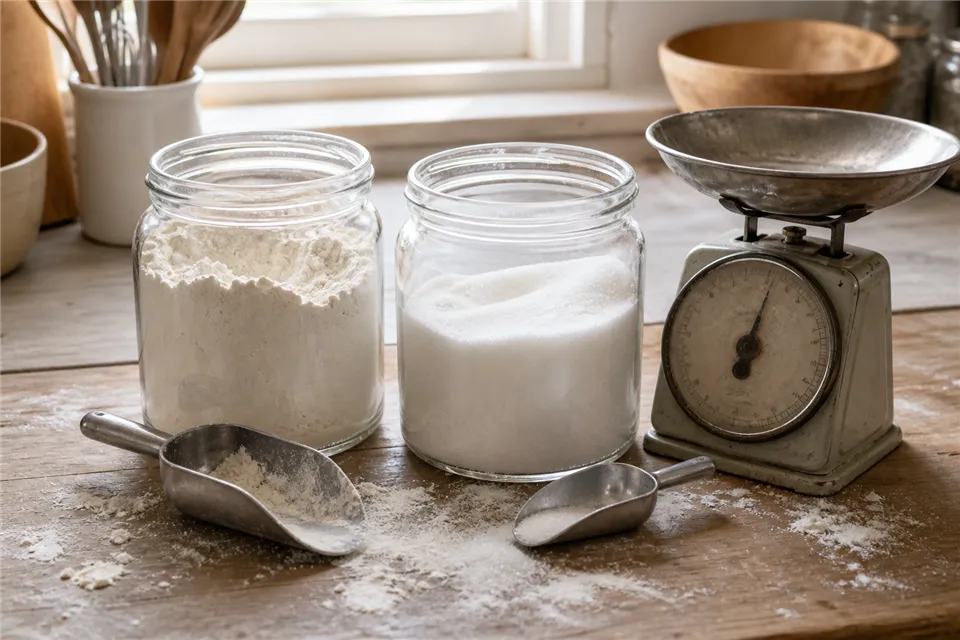
For a dry ingredient, the relevant value is often bulk density. Bulk density includes the air spaces between particles. It can change when the ingredient is:
-
Scooped or poured
-
Sifted
-
Compacted
-
Shaken during transport
-
Exposed to moisture
-
Ground to a different particle size
-
Measured with a different container
Suppose loose all-purpose flour is assigned an illustrative bulk density of 0.53 g/mL:
V = 1,000 ÷ 0.53 V ≈ 1,886.8 mL That does not mean every 1 kg bag of flour fills exactly 1,886.8 mL. A settled or tightly packed sample can occupy less space than freshly sifted flour.
Granulated sugar is generally denser than flour because its particles settle differently and leave smaller air spaces. However, granulated, caster, brown, and powdered sugars do not have the same bulk density.
For repeatable baking, weighing dry ingredients is usually more dependable than converting kilograms into a measuring-jug volume.
Converting a Custom Material
The same equation works for household, commercial, and manufacturing materials when a reliable density is available.
Suppose a product specification gives liquid soap a density of 1.06 g/mL. You need to find the volume of 2.5 kg.
Start with:
V(mL) = m(kg) × 1,000 ÷ ρ(g/mL) Substitute the values:
V = 2.5 × 1,000 ÷ 1.06 V ≈ 2,358.5 mL Convert milliliters to liters:
2,358.5 mL ÷ 1,000 ≈ 2.36 L Under the stated density assumption:
2.5 kg ≈ 2,358.5 mL Liquid-soap formulations vary, so this result applies only to the assumed 1.06 g/mL density. A manufacturer’s technical data or a measured density is preferable for packaging and production calculations.
For other amounts or custom density values, use the site’s kg to mL calculator. It keeps the substance density visible so a water-based assumption is not applied accidentally.
How to Measure Density When It Is Unknown
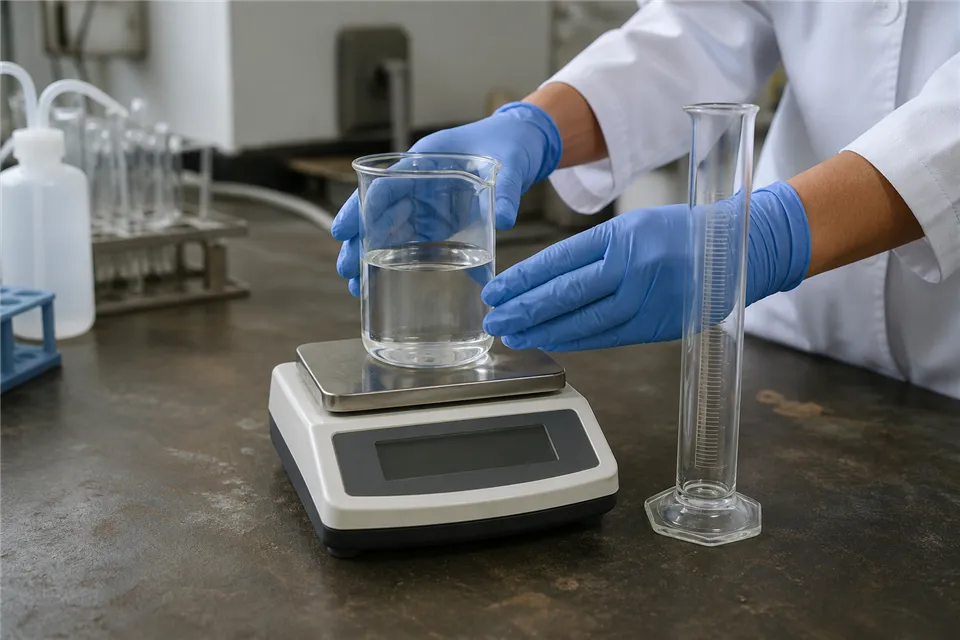
If no reliable density is available, it can be estimated from a measured sample:
ρ = m ÷ V A basic process is:
-
Weigh an empty container.
-
Add a known volume of the material.
-
Weigh the filled container.
-
Subtract the empty-container mass.
-
Divide the material mass in grams by its volume in milliliters.
For example, suppose 250 mL of liquid has a measured mass of 287.5 g:
ρ = 287.5 ÷ 250 ρ = 1.15 g/mL One kilogram of the same liquid would occupy:
V = 1,000 ÷ 1.15 V ≈ 869.6 mL This method is suitable for an estimate when the scale and container are accurate enough for the intended purpose. Precision laboratory measurements require controlled temperature, calibrated equipment, and a documented procedure.
Factors That Change the Conversion
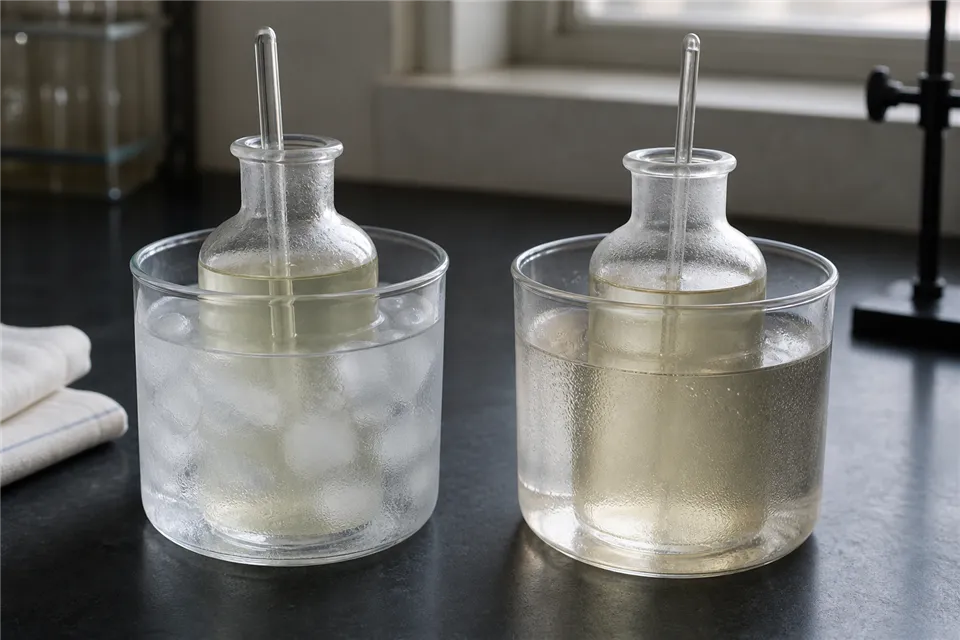
A density value should describe the actual material and its operating condition. Several variables can alter the result.
Temperature
Many liquids expand when heated, which reduces their density. The same 1 kg mass may therefore occupy more milliliters at a higher temperature.
Product composition
Whole milk, skim milk, syrups, detergents, oils, and paints are mixtures. Different formulations can have different densities even when their product names are similar.
Moisture content
Honey, flour, sugar, powders, and grains can absorb or lose moisture. This changes mass, volume, and bulk density.
Packing and settling
Dry particles leave air spaces. Shaking, vibration, scooping, or compression changes those spaces and alters the measured volume.
Pressure
Pressure has a limited effect on many household liquids but can be important in precision work. It has a much larger influence on gases, so gas mass-to-volume conversions also require temperature and pressure conditions.
Measurement and rounding
A kitchen scale, measuring jug, product data sheet, and laboratory balance do not provide the same precision. The final number should not contain more decimal places than the input measurements support.
Reverse Conversion: mL to kg
If volume and density are known, calculate mass using:
m(kg) = V(mL) × ρ(g/mL) ÷ 1,000 For example, 750 mL of oil at 0.92 g/mL has a mass of:
m = 750 × 0.92 ÷ 1,000 m = 0.69 kg This reverse calculation uses the same density relationship. A separate guide explains how to convert milliliters to kilograms for water and other materials.
Common kg-to-mL Conversion Errors
Treating 1 kg as 1,000 mL for every substance
The shortcut works approximately for water. Applying it to oil, honey, flour, paint, or another material ignores density.
Confusing mass with volume
Kilograms describe mass. Milliliters describe volume. They are connected through density but are not two names for the same measurement.
Using the wrong density unit
Entering 920 kg/m³ as though it were 920 g/mL creates an unusable result. Convert the density or select the matching formula first.
Forgetting the kilogram-to-gram conversion
When density is in g/mL, multiply kilograms by 1,000 before dividing by density.
Treating dry bulk density as fixed
Flour, sugar, powders, and grains can settle or compact. An approximate table cannot guarantee the volume of a particular package.
Using an unrelated product density
Vegetable oil, olive oil, motor oil, and essential oil do not necessarily share the same density. Use the value for the specific material.
Rounding too early
Keep extra digits during the calculation, then round the final result to a practical level. Early rounding can create a noticeable error when converting larger quantities.
Frequently Asked Questions
How many mL are in 1 kg of water?
For ordinary household use, 1 kg of water is approximately 1,000 mL, which is also 1 liter. This uses the common density approximation of 1.00 g/mL. For precision work, water density should be adjusted for temperature because it is not exactly 1 g/mL under every condition.
Is 1 kg always equal to 1,000 mL?
No. One kilogram equals approximately 1,000 mL only for a substance with a density close to 1 g/mL, such as water. Oil occupies more than 1,000 mL per kilogram, while denser materials such as honey occupy less. The substance’s density determines the answer.
How many mL are in half a kilogram?
Use the material’s density:
V = 0.5 × 1,000 ÷ ρ For water at the common 1 g/mL approximation, 0.5 kg equals about 500 mL. For oil at 0.92 g/mL, the same mass occupies about 543.5 mL.
How many mL are in 1 kg of milk?
Using an illustrative milk density of 1.03 g/mL:
1,000 ÷ 1.03 ≈ 970.9 mL The exact result varies with temperature, fat content, solids, and product formulation. Use the density shown on a reliable specification when greater precision is required.
How many mL are in 1 kg of cooking oil?
At an assumed density of 0.92 g/mL, 1 kg of cooking oil occupies approximately 1,087 mL. Different oils have different densities, and temperature also affects the result. Therefore, 1,087 mL should be treated as an example rather than one fixed value for every cooking oil.
Why does 1 kg of honey occupy less than 1,000 mL?
Honey is denser than water, so each milliliter contains more mass. At an illustrative density of 1.42 g/mL, 1 kg occupies about 704.2 mL. The exact figure varies because honey’s composition, moisture content, and temperature are not identical across products.
Does temperature affect a kg-to-mL conversion?
Yes. Temperature can change a substance’s density. Many liquids expand when heated, so the same mass occupies a larger volume. Household conversions may use a standard approximation, while laboratory and commercial calculations should use a density measured or specified at the relevant temperature.
Can flour be converted accurately from kg to mL?
Only approximately unless the flour’s bulk density and packing condition are known. Sifted, scooped, settled, and compressed flour can occupy different volumes at the same mass. For baking consistency, measuring 1 kg of flour with a scale is more reliable than converting it to milliliters.
The Reliable Conversion Rule
The correct response to how many ml in a kg is not one fixed number. For water, use approximately 1,000 mL. For another substance, calculate:
V(mL) = m(kg) × 1,000 ÷ ρ(g/mL) Check the substance, density unit, temperature, and required precision before using the result. If density is below 1 g/mL, 1 kg occupies more than 1,000 mL. If it is above 1 g/mL, the same kilogram occupies less.