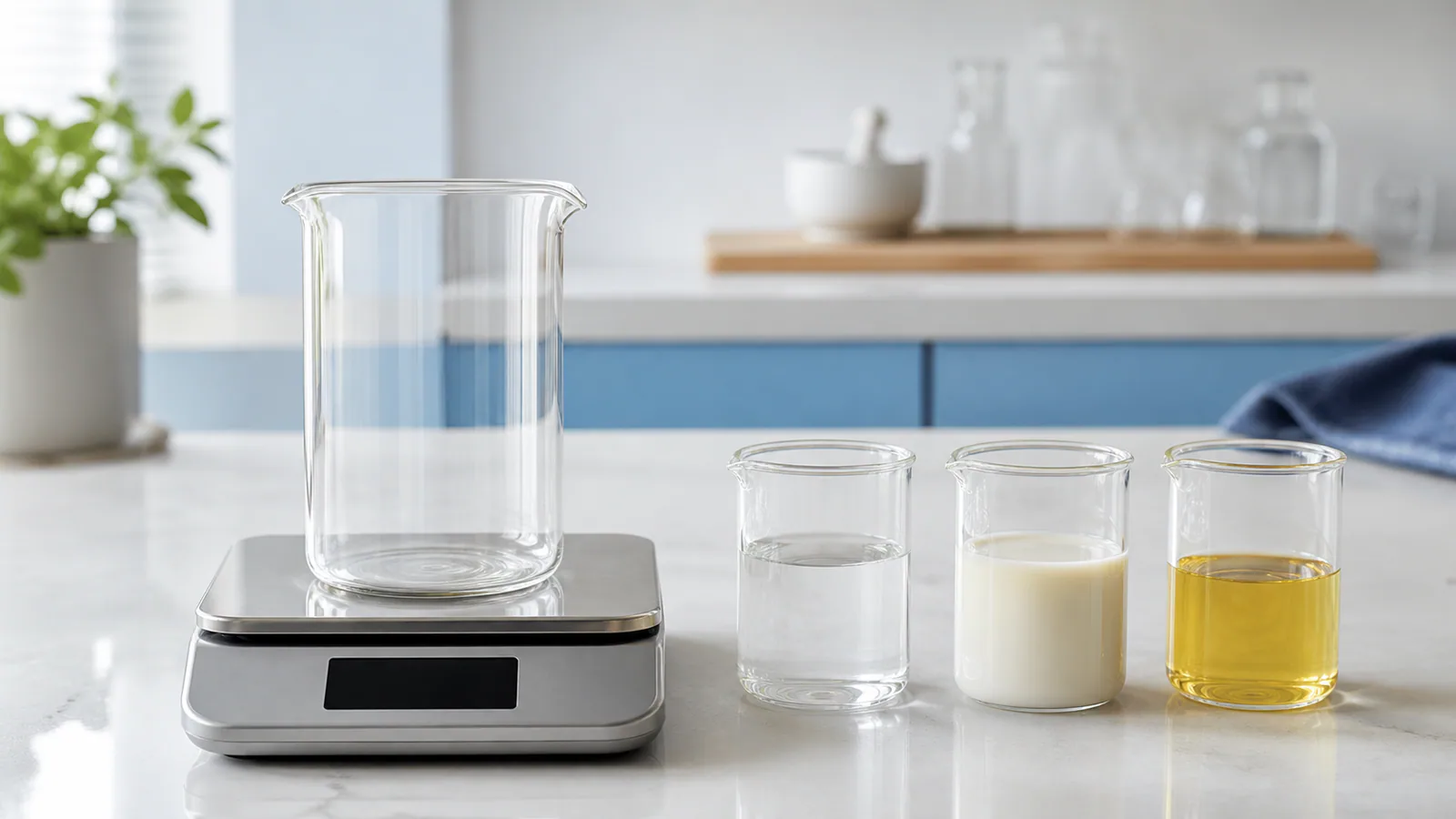
Knowing how to convert mL to kg is useful when a recipe, laboratory instruction, product label, or production sheet gives volume in milliliters but requires mass in kilograms. The calculation is not a simple unit swap because milliliters measure volume, while kilograms measure mass. You also need the density of the substance.
The basic formula is:
Mass (kg) = Volume (mL) × Density (g/mL) ÷ 1,000
For example, 500 mL of water is approximately 0.5 kg because water has a density close to 1 g/mL. The same volume of cooking oil weighs less, while 500 mL of honey weighs more. This guide explains the formula, density units, conversion steps, practical examples, common mistakes, and limitations that can affect the answer.
Quick Answer
To convert milliliters to kilograms:
- Find the substance’s density in grams per milliliter.
- Multiply the volume in mL by the density in g/mL.
- Divide the result by 1,000 to convert grams to kilograms.
kg = (mL × density in g/mL) ÷ 1,000
There is no universal mL-to-kg conversion factor. The result changes with the substance because equal volumes of different materials can have different masses.
Why Density Is Needed to Convert mL to kg
A milliliter is a unit of volume. It indicates how much space a substance occupies. A kilogram is a unit of mass, meaning the amount of matter in that substance. Although mass is the technically correct term, people often refer to it as weight in everyday measurements.
Since volume and mass represent different physical quantities, they cannot be converted directly without additional information. Density provides that connection.
Density describes how much mass is packed into a particular volume:
Density = Mass ÷ Volume
A dense liquid has more mass within the same volume than a less dense liquid. For example, 1,000 mL of honey is heavier than 1,000 mL of vegetable oil because honey has a higher density.
This is why an accurate mL to kg converter must either let you select a substance or enter its density. A calculator that treats every liquid like water can give incorrect results.
The mL to kg Conversion Formula
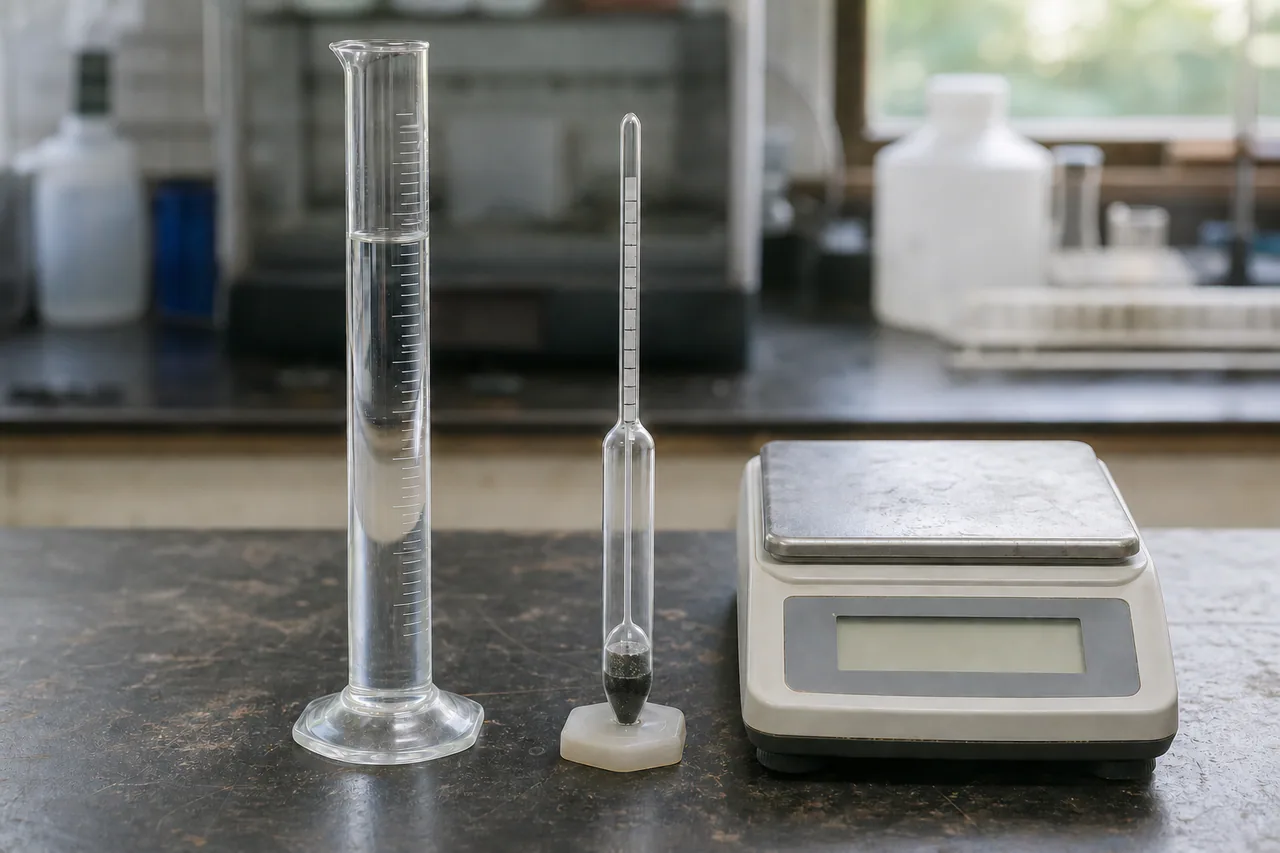
When density is expressed in grams per milliliter, use:
Mass (kg) = Volume (mL) × Density (g/mL) ÷ 1,000
The variables are:
- Mass is the answer in kilograms.
- Volume is the amount in milliliters.
- Density is the substance’s mass per unit volume in g/mL.
- 1,000 converts the calculated grams into kilograms.
Suppose you have 800 mL of a liquid with a density of 1.15 g/mL:
Mass = 800 × 1.15 ÷ 1,000
Mass = 0.92 kg
The 800 mL of liquid therefore has a mass of approximately 0.92 kg.
Formula when density is in kg/L
The numerical value of a density in g/mL is the same when written in kg/L. For example:
0.92 g/mL = 0.92 kg/L
First convert milliliters to liters:
Liters = mL ÷ 1,000
Then calculate:
Mass (kg) = Volume (L) × Density (kg/L)
For 800 mL of the same liquid:
800 mL ÷ 1,000 = 0.8 L
0.8 L × 1.15 kg/L = 0.92 kg
Both methods produce the same result.
Formula when density is in kg/m³
Density data for industrial and scientific materials may be supplied in kilograms per cubic meter. One cubic meter contains 1,000,000 mL, so use:
Mass (kg) = Volume (mL) × Density (kg/m³) ÷ 1,000,000
For 2,500 mL of a liquid with a density of 850 kg/m³:
Mass = 2,500 × 850 ÷ 1,000,000
Mass = 2.125 kg
Checking the density unit before calculating prevents errors involving factors of 1,000.
How to Convert mL to kg Step by Step
Follow this process for liquids, ingredients, and other substances:
- Identify the substance. Density is specific to the material. Water, milk, oil, and honey do not share the same density.
- Find an appropriate density value. Use a product specification, laboratory reference, manufacturer document, or Safety Data Sheet when accuracy matters.
- Check the density unit. Determine whether it is stated in g/mL, kg/L, or kg/m³.
- Insert the values into the correct formula. If density is in g/mL, multiply mL by density and divide by 1,000.
- Round sensibly. Do not report more decimal places than the input measurements justify.
- State that the result is approximate when necessary. Temperature, composition, air bubbles, and ingredient compaction can affect density.
For an immediate calculation, an mL to kg calculator can perform these steps automatically. You still need to choose the correct substance or enter a reliable density rather than assuming that every material has the density of water.
Common Substance Densities
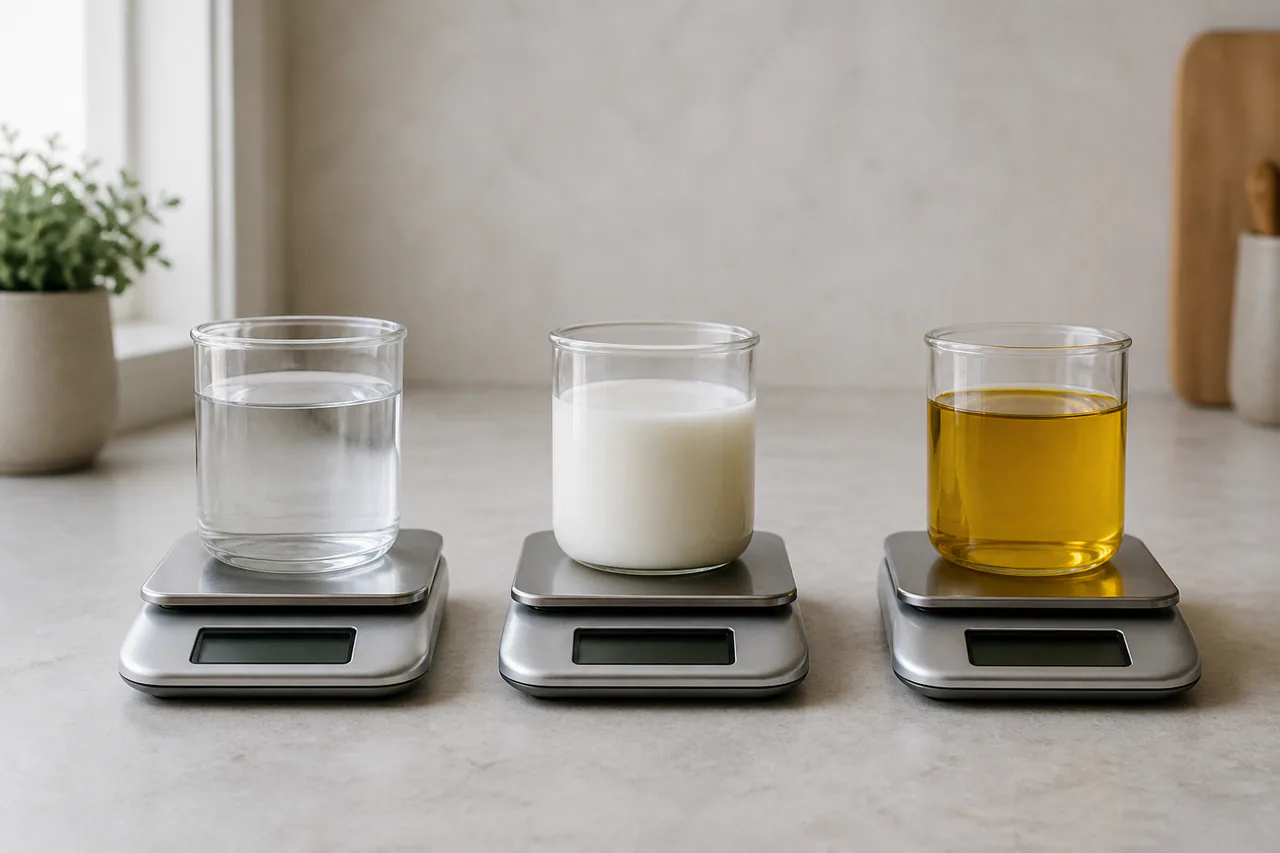
The following values are practical approximations. Actual density can vary with temperature, formulation, moisture, and product composition.
| Substance | Approximate density | Mass of 1,000 mL |
|---|---|---|
| Water at about 20°C | 0.998 g/mL | 0.998 kg |
| Whole milk | 1.03 g/mL | 1.03 kg |
| Vegetable oil | 0.92 g/mL | 0.92 kg |
| Olive oil | 0.91–0.92 g/mL | 0.91–0.92 kg |
| Honey | 1.40–1.45 g/mL | 1.40–1.45 kg |
| Glycerin | 1.26 g/mL | 1.26 kg |
| Ethanol | 0.789 g/mL | 0.789 kg |
| Gasoline | 0.71–0.77 g/mL | 0.71–0.77 kg |
These figures should not replace verified product data in chemical processing, medicine, engineering, shipping compliance, or commercial production.
mL to kg Conversion Table
This table compares water, milk, and cooking oil using approximate densities of 1.00 g/mL, 1.03 g/mL, and 0.92 g/mL respectively.
| Volume | Water | Milk | Cooking oil |
|---|---|---|---|
| 50 mL | 0.050 kg | 0.052 kg | 0.046 kg |
| 100 mL | 0.100 kg | 0.103 kg | 0.092 kg |
| 250 mL | 0.250 kg | 0.258 kg | 0.230 kg |
| 500 mL | 0.500 kg | 0.515 kg | 0.460 kg |
| 750 mL | 0.750 kg | 0.773 kg | 0.690 kg |
| 1,000 mL | 1.000 kg | 1.030 kg | 0.920 kg |
| 2,000 mL | 2.000 kg | 2.060 kg | 1.840 kg |
| 5,000 mL | 5.000 kg | 5.150 kg | 4.600 kg |
The water column uses the convenient density approximation of 1.00 g/mL. At ordinary room temperature, pure water’s density is slightly lower, so highly precise work should use a temperature-appropriate value.
Worked mL to kg Examples
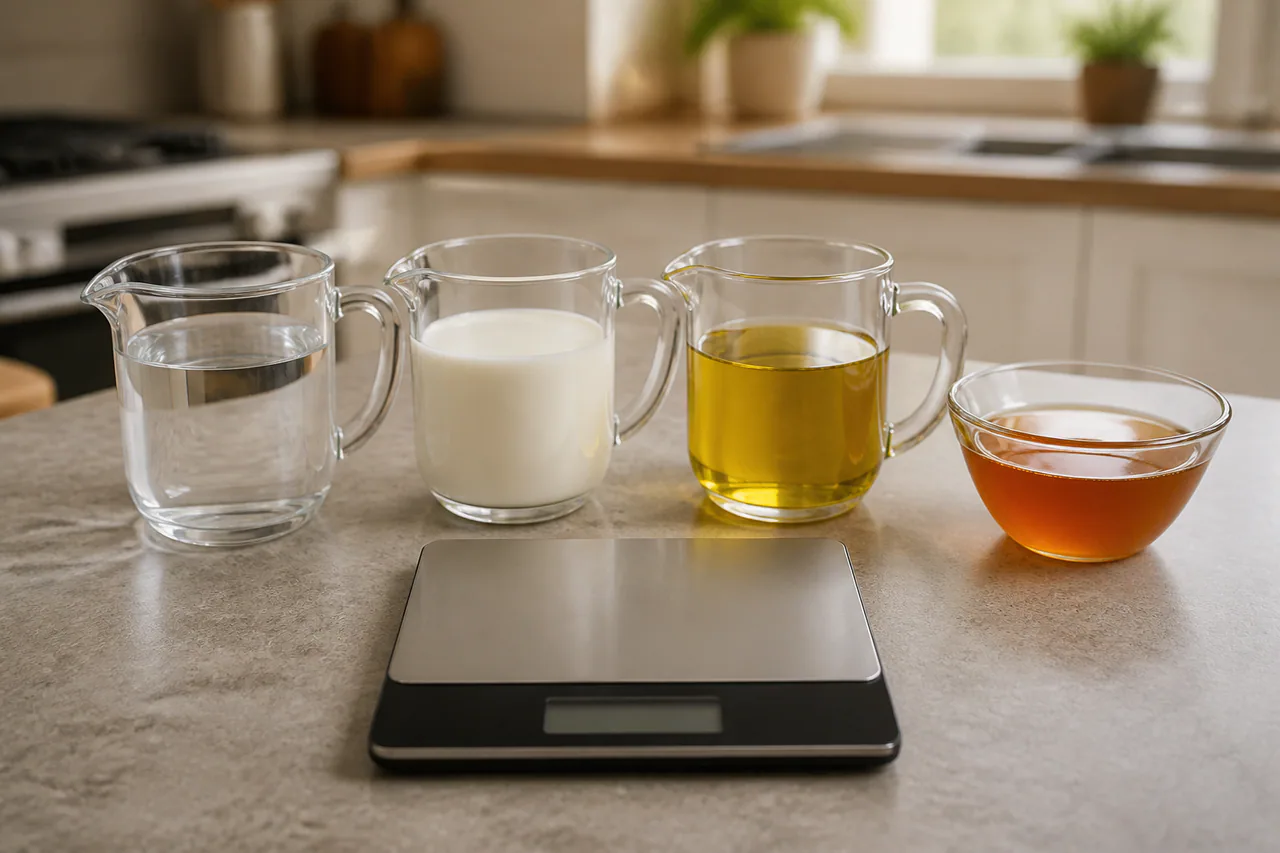
Example 1: Convert 500 mL of water to kg
Using water density as approximately 1 g/mL:
Mass = 500 × 1 ÷ 1,000
Mass = 0.5 kg
Therefore, 500 mL of water is approximately 0.5 kg.
Example 2: Convert 750 mL of milk to kg
Assume the milk has a density of 1.03 g/mL:
Mass = 750 × 1.03 ÷ 1,000
Mass = 0.7725 kg
Rounded to three decimal places, 750 mL of milk is approximately 0.773 kg.
Milk density varies slightly according to fat, protein, sugar, and temperature. Use product-specific data if a small difference matters.
Example 3: Convert 2,500 mL of cooking oil to kg
Using an approximate cooking-oil density of 0.92 g/mL:
Mass = 2,500 × 0.92 ÷ 1,000
Mass = 2.3 kg
Therefore, 2,500 mL of cooking oil is approximately 2.3 kg. The result is lower than the water conversion because oil is less dense.
Example 4: Convert 300 mL of honey to kg
Assume the honey density is 1.42 g/mL:
Mass = 300 × 1.42 ÷ 1,000
Mass = 0.426 kg
The estimated mass of 300 mL of honey is 0.426 kg. Moisture content and temperature can change the density and flow behavior of honey.
Example 5: Convert 1,500 mL of gasoline to kg
Gasoline density varies by formulation and temperature. Using an example density of 0.74 g/mL:
Mass = 1,500 × 0.74 ÷ 1,000
Mass = 1.11 kg
Thus, 1,500 mL of this gasoline would have an approximate mass of 1.11 kg.
Example 6: Convert 250 mL using custom density
Suppose a laboratory solution has a verified density of 1.18 g/mL:
Mass = 250 × 1.18 ÷ 1,000
Mass = 0.295 kg
The solution has a calculated mass of 0.295 kg. For laboratory work, record the density’s reference temperature and the precision of the measuring equipment.
Is 1,000 mL Always Equal to 1 kg?
No. The statement 1,000 mL equals 1 kg is a useful approximation for water, not a universal rule.
For 1,000 mL of a substance, the formula simplifies to:
Mass in kg = density in g/mL
This means:
- 1,000 mL of water at the common 1 g/mL approximation equals 1 kg.
- 1,000 mL of milk at 1.03 g/mL equals 1.03 kg.
- 1,000 mL of oil at 0.92 g/mL equals 0.92 kg.
- 1,000 mL of honey at 1.42 g/mL equals 1.42 kg.
The rule also works in reverse conceptually: materials denser than water generally weigh more than 1 kg per liter, while materials less dense than water generally weigh less.
Converting Dry Ingredients from mL to kg
Dry ingredients such as flour and sugar can also be described by volume, but their conversion is often less exact than a liquid conversion. Their bulk density includes the spaces between particles.
Several factors can change the amount of material within the same measured volume:
- How finely the ingredient is ground
- Whether it is sifted
- How firmly it is packed
- Moisture content
- Settling during transport or storage
- Whether the measuring container is leveled
A cup or container of compacted flour contains more flour than the same volume filled loosely. Granulated sugar, powdered sugar, and brown sugar also have different bulk densities.
For ordinary cooking, use an ingredient-specific conversion supported by the recipe source. For commercial production, measuring dry ingredients directly with a calibrated scale is usually more reliable than converting their volume to mass.
How Temperature Affects the Conversion
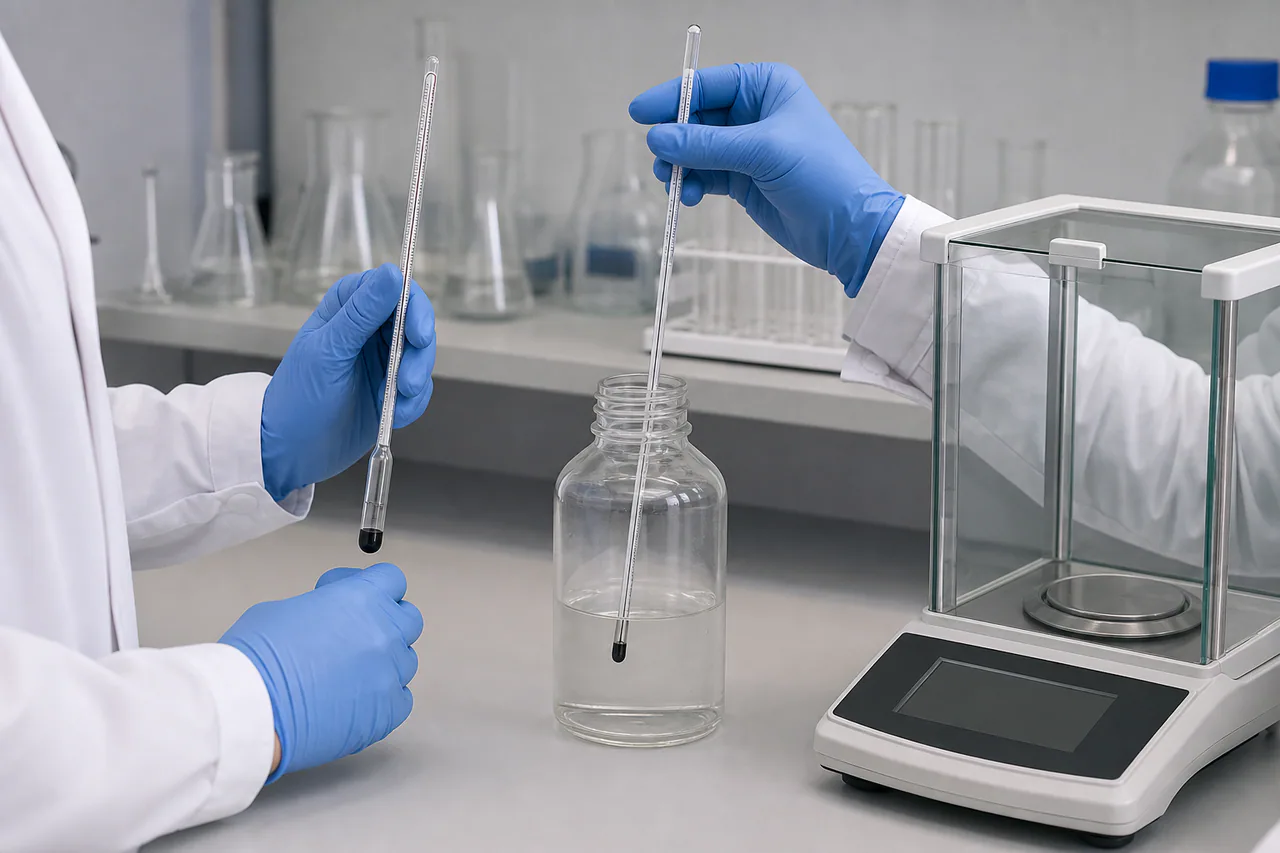
Density can change when temperature changes. Most liquids expand as they become warmer. The same mass then occupies slightly more volume, which lowers the density.
This variation is small enough to ignore in many household calculations. It matters more in:
- Laboratory measurements
- Fuel storage and transportation
- Chemical manufacturing
- Pharmaceutical preparation
- Large industrial batches
- High-accuracy engineering work
Water is often rounded to 1 g/mL for everyday calculations. Its density is approximately 0.998 g/mL near 20°C and is closest to 1 g/mL near 4°C. If you are converting large quantities or require high precision, use a density measured or documented at the relevant temperature.
Gas calculations require additional care because gas density can change substantially with both temperature and pressure.
How to Find the Density of a Substance
Use a source that matches the exact substance and, when relevant, its concentration and temperature. Reliable places to check include:
- A manufacturer’s technical data sheet
- A chemical Safety Data Sheet
- A recognized scientific reference
- A product specification
- A laboratory measurement
- A food composition or ingredient database
Avoid using the density of a general category when a specific formulation is available. “Oil,” for example, could refer to olive oil, motor oil, mineral oil, or another product with a different density.
For solutions, confirm whether the density applies to the finished solution rather than only its solvent. Sugar concentration, dissolved salts, alcohol percentage, and other ingredients can change density.
How to Convert kg Back to mL
To reverse the calculation, divide the mass by density rather than multiplying:
Volume (mL) = Mass (kg) × 1,000 ÷ Density (g/mL)
For example, calculate the volume of 2 kg of cooking oil with a density of 0.92 g/mL:
Volume = 2 × 1,000 ÷ 0.92
Volume ≈ 2,173.91 mL
Rounded to the nearest milliliter, 2 kg of that cooking oil occupies approximately 2,174 mL.
This reverse formula explains why 1 kg does not always contain 1,000 mL. One kilogram of a lighter liquid occupies more space than one kilogram of a denser liquid.
Common mL to kg Conversion Mistakes
Treating every substance like water
The 1:1 relationship between liters and kilograms is only an approximation for water. Applying it to oil, honey, fuel, or chemical solutions produces inaccurate results.
Ignoring the density unit
A density of 920 kg/m³ is equivalent to 0.92 g/mL, not 920 g/mL. Always match the formula to the stated unit.
Multiplying when performing the reverse conversion
To find mass from volume, multiply by density. To find volume from mass, divide by density.
Forgetting to convert grams into kilograms
Multiplying mL by a density in g/mL produces grams. Divide that result by 1,000 to obtain kilograms.
Using an unsuitable density
The density should match the actual material, concentration, and relevant temperature. A broad internet estimate may not be appropriate for technical work.
Reporting excessive precision
If the volume and density are approximate, the result is also approximate. Writing many decimal places does not make an uncertain input more accurate.
Frequently Asked Questions
How many kilograms is 1 mL of water?
Using the everyday approximation that water has a density of 1 g/mL, 1 mL of water is 1 gram, or 0.001 kg. The exact value can vary slightly with temperature, but 0.001 kg is appropriate for most household calculations.
How many kg is 100 mL?
The answer depends on density. For water, 100 mL is approximately 0.1 kg. For cooking oil with a density of 0.92 g/mL, it is about 0.092 kg. Multiply 100 by the substance’s density in g/mL and divide by 1,000.
How many kg is 500 mL?
Five hundred milliliters of water is approximately 0.5 kg. The same volume of milk is roughly 0.515 kg at a density of 1.03 g/mL, while 500 mL of cooking oil is about 0.46 kg at 0.92 g/mL.
Does 1 mL equal 1 gram?
Only when the substance has a density of 1 g/mL. Water is close to this value under common conditions, so 1 mL of water is approximately 1 gram. One milliliter of oil weighs less, while 1 mL of honey weighs more.
Can I convert mL to kg without knowing density?
You cannot obtain a reliable general conversion without density or equivalent mass-and-volume information. You may estimate using the density of a similar material, but the result should be labeled approximate. For water, using 1 g/mL is normally sufficient for everyday purposes.
What is the mL to kg formula for oil?
Use kg = mL × oil density in g/mL ÷ 1,000. If cooking oil has an approximate density of 0.92 g/mL, then 1,000 mL weighs about 0.92 kg. Check the specific oil’s density for a more accurate result.
Is 1 liter always equal to 1 kg?
No. One liter is a measure of volume, while one kilogram measures mass. One liter of water is close to 1 kg, but a liter of vegetable oil may be about 0.92 kg, and a liter of honey may exceed 1.4 kg.
Can an mL to kg calculation be used for gases?
It can be done if the gas density is known at the specified temperature and pressure. However, gas density changes much more noticeably with these conditions than liquid density. Gas calculations should therefore include both temperature and pressure rather than relying on a general density estimate.
Getting the Conversion Right
The reliable way to understand how to convert mL to kg is to connect volume and mass through density. Multiply milliliters by density in g/mL, then divide by 1,000. Water provides a convenient approximation, but it should never be treated as the rule for every substance.
For everyday calculations, a suitable average density usually provides a practical estimate. For laboratory, manufacturing, pharmaceutical, or engineering work, use a verified density that matches the exact material, concentration, and temperature.